
We get this question from both sides of the table. An employer asks whether it can stop a senior salesperson from joining a competitor with the client list. An employee asks whether the two-page offer letter he signed years ago really prevents him from taking a better job next month.
The short answer: non-compete clauses are valid in the UAE, but only within clear limits, and many of the clauses we review go well beyond them.
What the law says
Non-compete clauses in mainland employment are governed by Article 10 of the UAE Labour Law (Federal Decree-Law No. 33 of 2021) and its Executive Regulations. For a clause to be enforceable:
- The employee’s role must give access to the employer’s clients or confidential business information.
- The restriction must be limited in time, place and type of work.
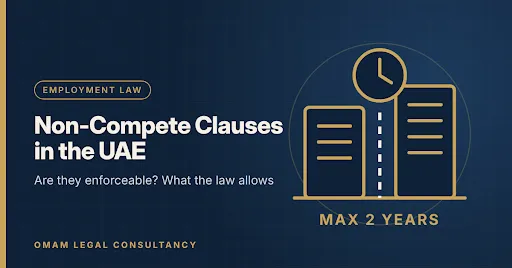
- The time limit cannot exceed two years from the end of employment.
- The restriction must be no wider than needed to protect the employer’s legitimate business interests.
A clause that bans an employee from “working in any similar business anywhere in the GCC for five years” will not survive in that form. A clause restricting a key account manager from working for three named competitors in Dubai for twelve months has a much better chance.
When the clause does not apply
The Executive Regulations recognise several situations where a non-compete will not bind the employee, including:
- Both parties agree in writing to waive it.
- The employee, or the new employer, pays the former employer compensation of up to three months’ salary, with the former employer’s written agreement.
- The employer ended the contract in breach of the law or of its own contractual obligations.
- Certain professional categories exempted by ministerial decision.
Leaving during probation has its own rules on notice and on compensating the former employer for recruitment costs, so check those separately.
What an employer has to prove
This is where many claims fail. The employer must prove that the former employee actually competed in breach of the clause and that the employer suffered damage as a result. The court then decides the amount of compensation.
The claim must also be filed within one year from when the employer became aware of the breach. Waiting to see how much damage builds up is a common and expensive mistake.
Practical advice for employers
- Draft narrowly. Name the competing activities, define the territory and keep the period proportionate to the role. A tailored clause is far more valuable than an aggressive one.
- Use it only where it is justified. Sales leads, key account managers, senior executives and technical staff with access to pricing or know-how. Not every role needs one.
- Combine it with confidentiality and non-solicitation terms. These often protect the business better than a broad non-compete.
- Document the departure. Exit interviews, return of devices, and a written reminder of the clause.
- Act quickly. Send a legal notice as soon as a breach is suspected, and keep the one-year deadline in mind.
Our contract drafting team prepares employment contracts and restrictive covenants that match the legal limits. See also UAE Commercial Contracts: Essential Clauses Every Business Needs.
Practical advice for employees
- Read the clause before resigning, not after accepting the new offer.
- Check whether it actually meets the time, place and activity limits.
- If the former employer terminated you unlawfully, the clause may not apply.
- Consider negotiating a written waiver or a settlement as part of your exit, especially if you are also discussing your end of service benefits.
For senior roles, also read our guide to senior executive termination in the UAE.
Free zones are different
DIFC and ADGM have their own employment laws, and the rules on restrictive covenants there are not identical to the mainland. Check which law governs your contract before relying on this guide.
Looking For UAE Business Setup Legal Guidance?
Omam Legal Consultancy helps founders, investors, and entrepreneurs structure UAE companies correctly from the outset — covering jurisdiction selection, corporate tax readiness, UBO compliance, AML planning, shareholder protection, and banking-focused setup strategies that prevent costly legal and operational mistakes.
Frequently asked questions about Non-Compete Clauses
1. What is the maximum non-compete period in the UAE?
Two years from the end of the employment relationship for mainland employees. Many courts will expect a shorter period to be justified by the role.
2. Is a non-compete valid if it covers the whole UAE?
It depends on the role and the business. A nationwide restriction can be acceptable for a business that operates across the country, but it must still be limited in time and activity and be no wider than necessary.
3. Can my former employer stop my new employer from hiring me?
The main remedy is a claim for compensation, which the employer must prove. That is why many disputes are settled through a written waiver or a negotiated payment.
4. Can I buy my way out of a non-compete?
The Executive Regulations allow the clause to fall away if compensation of up to three months’ salary is paid to the former employer with its written agreement.
5. How long does an employer have to sue for breach of a non-compete?
One year from the date the employer became aware of the breach.
Talk to us
Talk to us
Whether you are drafting a non-compete or facing one, message us on WhatsApp and we will review the clause and tell you where you stand.
This article is for general information only and is not legal advice.