
You may believe you have prepared a complete set of documents for a court filing, a government application, a real estate transaction, or the opening of a corporate bank account. You submit copies of your passport, Emirates ID, or trade licence, only to find that the application is delayed or rejected because the documents were not notarized correctly as true copies.
This issue arises frequently in Dubai’s legal and commercial environment. Many individuals, business owners, tenants, and investors mistakenly assume that any photocopy bearing a typing centre stamp, certification note, or ‘seen original’ endorsement is legally sufficient. In many cases, it is not. The distinction between a true copy notarization and an informal copy endorsement is a legal distinction — and acting on the wrong assumption creates real consequences.
Where a notarized true copy is required by a court, government authority, bank, regulator, or counterparty, failure to comply can lead to rejected filings, delayed transactions, regulatory non-compliance, and in some cases the exclusion of documents from consideration in formal legal proceedings.
This guide explains the practical requirements for true copy notarization in Dubai, identifies the most common reasons such documents are rejected, sets out who is legally authorised to perform notarization in the UAE, and provides clear guidance on the steps required to ensure that your documents are properly prepared and accepted for official use.
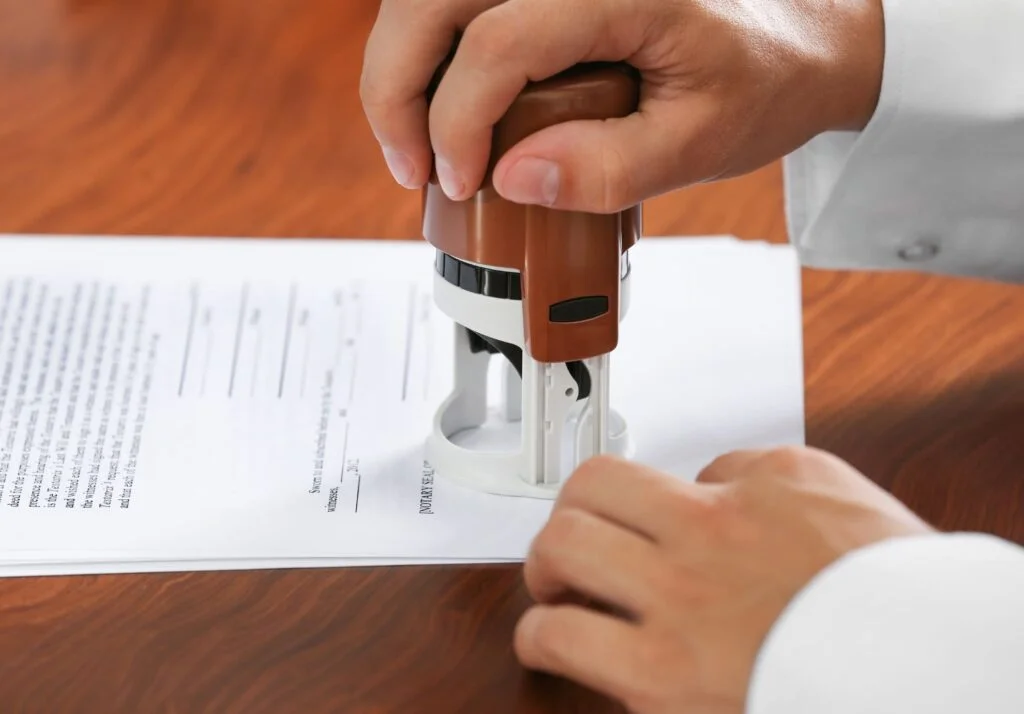
Why Not Every Certified Copy Has Legal Effect in Dubai
One of the most persistent misconceptions in the UAE is that any copy stamped as a ‘certified true copy’ automatically carries legal weight. That assumption is incorrect — and relying on it consistently creates the most avoidable category of document rejection in Dubai’s legal and commercial environment.
A true copy notarization is a formal legal act that must be carried out by a duly authorised notary public in accordance with the applicable legal and procedural framework. Under the UAE’s notarial framework — principally Federal Decree-Law No. 20 of 2022 Regulating the Notary Profession — the notary must either:
- personally compare the copy against the original document presented to them in person; or
- verify the document through the official electronic system of the issuing authority, where such verification is permitted under the applicable rules.
A typing centre does not have the legal authority to perform notarization. A simple certification or endorsement from a private service provider — however formally it appears — is not equivalent to notarization and will not ordinarily satisfy the requirements of Dubai Courts, government entities, or regulated financial institutions.
This means that if a person or service provider offers to ‘certify’ your passport, Emirates ID, or trade licence copy without the original being properly presented to, or verified by, a licensed notary, there is a substantial risk that the document will be rejected when submitted for official use. The risk is not theoretical — it is the most common practical failure point in document preparation across Dubai’s commercial and legal processes.
The Legal Framework: Who Is Authorised to Notarize True Copies in Dubai
Understanding who is legally authorised to notarize true copies in Dubai is essential before any notarization step is taken. The applicable framework is set by Federal Decree-Law No. 20 of 2022 Regulating the Notary Profession, supplemented by Cabinet Resolution No. 16 of 2024 (Executive Regulations). This law applies across the UAE including free zones, while recognising that local judicial authorities and financial free zones may operate their own supplementary arrangements.
Public Notaries Through Dubai Courts
The most broadly accepted route for true copy notarization in Dubai is through the public notary channel accessed via Dubai Courts. Public notaries operate within the formal judicial infrastructure and their notarized copies are widely accepted by onshore government authorities, banks, regulatory bodies, and the courts. For the majority of standard documents — passports, Emirates IDs, trade licences, constitutional documents, and corporate authority records — the Dubai Courts notary channel remains the primary and most broadly recognised option.
Private Notaries
Federal Decree-Law No. 20 of 2022 expressly recognises private notaries as authorized notarial actors. Private notaries are licensed individuals listed in the competent register who may perform notarial services — including true copy certification — through a licensed office or law firm. For businesses managing time-sensitive transactions, complex multi-party signings, or documents requiring specialized handling, private notaries offer greater scheduling flexibility and a more tailored service experience than standard public notary channels. The legal effect of their notarizations is recognized under the same federal framework.
DIFC Courts Notary Service
For DIFC-based entities or where the document is intended for use within the DIFC legal ecosystem, the DIFC Courts Notary Service — established by Resolution No. 1 of 2025 and affirmed by Dubai Law No. 2 of 2025 — provides a dedicated notarial channel. The DIFC Courts expressly state that this service covers the certification and attestation of true copies of documents, and that the service is automated for straightforward certification requirements. This channel is most relevant for DIFC-registered companies or where the receiving authority or counterparty operates specifically within the DIFC framework.
Lawyers and Legal Consultants
A licensed lawyer or legal consultant may be accepted as a certifier by some banks, universities, embassies, or private institutions for certain purposes. However, acceptance is not universal. Many government-facing procedures, court filings, and regulated transactions require a public or private notarial route, or a specific authority expressly accepted by the receiving body. Whether lawyer certification is sufficient must always be confirmed with the receiving authority before the document is prepared — not assumed.
Why True Copy Notarization Matters: Key Use Cases in Dubai
True copy notarization is commonly required in Dubai in connection with the following categories of transaction and procedure. In each case, the legal or commercial consequences of submitting an inadequately notarized copy can range from procedural delay to outright rejection of the application or filing.
- Court filings and legal disputes: In litigation before Dubai Courts, the DIFC Courts, or specialist tribunals, documentary evidence is scrutinised for authenticity and procedural compliance. A plain photocopy of a contract, corporate document, or identity record may be objected to or given reduced evidentiary weight if it has not been properly notarized.
- Regulatory and licensing processes: Government authorities and free zone regulators frequently require notarized copies of founding documents, identity records, and authority papers as part of licensing, renewal, or compliance procedures.
- Real estate and tenancy matters: Property transactions, mortgage registrations, and tenancy-related filings at the Dubai Land Department and Rental Disputes Center may require notarized copies of identity documents, title records, and corporate authority papers.
- Corporate transactions and banking requirements: Banks conducting KYC and compliance reviews, and counterparties conducting transaction due diligence, commonly require notarized copies of trade licences, incorporation documents, constitutional records, board resolutions, and signatory identity documents.
- Shareholder, board, and power of attorney documentation: Corporate authority documents and powers of attorney presented to government registries, counterparties, or courts often require notarization to establish the authenticity and validity of the authority being claimed.
- Identity verification in compliance-related procedures: Regulated entities — including financial institutions, professional firms, and government-linked entities — may require notarized identity document copies as part of mandatory due diligence processes under UAE AML and compliance frameworks.
Once a dispute arises or a formal filing is required, the standard of documentary scrutiny becomes significantly stricter. A plain photocopy may be insufficient precisely where authenticity, identity, authority, or evidentiary admissibility is in issue — which is to say, at the moments when the document matters most.
Practical Scenarios: Valid and Invalid True Copy Notarization
Valid Notarization Scenario A: In-Person Notarization at Dubai Courts
You attend before a licensed notary public through the Dubai Courts channel and present your original passport. The notary examines the original, compares it against the copy, confirms the match, affixes the required notarial endorsement including seal, signature, and transaction reference, and records the transaction in the official system. The notarized copy is then suitable for submission to the authority or institution that required it, subject to any further attestation requirements.
Valid Notarization Scenario B: Authorised Digital Notarization
Your lawyer arranges electronic notarization through an authorised platform where the notary verifies the document through an official government-linked electronic system. An electronically notarized true copy is issued with a verifiable digital reference. This route is valid under Federal Decree-Law No. 20 of 2022, which expressly recognises electronic signatures and e-documents notarized in accordance with the law as carrying the same evidentiary value as traditionally notarized instruments. The receiving authority must accept electronic notarization for this route to be suitable.
Valid Notarization Scenario C: Corporate Document Notarization
Your company submits a trade licence copy for notarization through the competent notarial channel with the supporting constitutional documents and signatory authority records. The document is properly reviewed, stamped, signed, and recorded by an authorised notary. The copy is then suitable for submission to a bank, regulatory body, or counterparty, subject to the receiving authority’s specific requirements.
Valid Notarization Scenario D: DIFC Courts Notary Service
A DIFC-incorporated entity uses the DIFC Courts Notary Service to certify a true copy of its certificate of incorporation for use in a financing transaction. The service processes the certification through its automated true copy system, producing a notarized output with a blockchain-verified transaction record through Hedera’s Distributed Ledger Technology. For DIFC-based transactions and counterparties, this channel is procedurally aligned and commercially efficient.
Rejection Scenario 1: Typing Centre Stamp Only
A document bears only a typing centre stamp stating ‘certified true copy’ or ‘seen original’. A typing centre is not a notary public and has no legal authority to issue a notarized true copy under UAE law. Such certification has no independent legal value where notarization is specifically required, and the document will be rejected by courts, government bodies, and most regulated institutions.
Rejection Scenario 2: Incomplete Notarial Endorsement
The document bears what appears to be a notarial stamp, but the notarial seal, signature, registration number, transaction reference, or other required formal element is missing or incomplete. An incomplete notarization does not satisfy the legal requirements and may be rejected for lacking the formal elements that establish its authenticity and allow it to be verified by the receiving authority.
Rejection Scenario 3: Notarization Without Proper Verification
The notary stamped the copy without actually comparing it to an original document, or without verifying the document through an authorised electronic system where required. A notarization carried out without proper verification of the original may be subject to challenge — particularly in litigation or regulatory proceedings where the authenticity of the document is in dispute — and may not withstand scrutiny before a court or authority.
Rejection Scenario 4: Notarized Copy of an Expired Document
A notarized copy is submitted of a passport that has since expired, an Emirates ID that has been renewed, or a trade licence that has lapsed. Even where the notarization itself was technically correct at the time it was performed, the receiving authority may refuse the document because the underlying identity or authority record is no longer current. For identity documents and regulatory records in particular, freshness of the underlying document is as important as the validity of the notarization.
Rejection Scenario 5: Incomplete Document — Missing Pages
Only the biographical data page of a passport was notarized, but the receiving authority requires visa pages, entry stamps, or the signature page. An incomplete notarized copy — one that does not include all pages relevant to the intended purpose — may be rejected for failing to provide the full document picture the authority requires. Before notarization, confirm exactly which pages of the document must be included.
Rejection Scenario 6: Unverified Digital Print
A document that was obtained as a printed scan from an email, messaging platform, or informal digital source is submitted for notarization. The notary is unable to verify that the print accurately represents the original document. Without satisfactory verification of the source and integrity of the document, the notarization may be incomplete or open to challenge, and the resulting copy may not be accepted by a court or authority that requires a properly notarized original.
Freshness of Identity Documents: A Practical Issue That Is Often Overlooked
There is no single universal federal rule in the UAE stating that all notarized true copies of identity documents automatically expire after a fixed period. However, as a matter of institutional practice across courts, government authorities, banks, and regulators in Dubai, recently notarized copies of passports, Emirates IDs, and similar identity documents are consistently preferred — and in many cases required.
The practical reason is straightforward. Identity documents are subject to renewal, expiry, and status changes that affect their legal reliability as records of a person’s identity. Specifically:
- A notarized copy of an expired passport is unlikely to be accepted for any immigration, banking, or regulatory purpose, regardless of when the notarization was performed.
- A notarized copy of an Emirates ID may lose practical usefulness once the card is renewed — even if the renewal number is similar — because the issuing authority’s records will reflect the new card as the current valid document.
- A notarized copy of a trade licence notarized before the most recent renewal may not reflect the current licensed activities, fee payment status, or validity period required by the receiving authority.
- For academic certificates and professional credentials, freshness matters less — but the receiving authority may still require a notarized copy made within a defined period before submission.
Accordingly, where a notarized identity document is being used for a new filing, banking process, or dispute, obtaining a fresh notarized true copy is the safer approach rather than assuming that an earlier notarization will still be accepted.
What Receiving Authorities Are Not Required to Do
A common and costly mistake is to assume that if a document is only slightly defective, the receiving authority will still accept it or allow the issue to be corrected later. That is a risky assumption that consistently leads to avoidable rejections and delays.
In practice, authorities in Dubai are not required to:
- treat typing centre certification as equivalent to notarization — it has no independent legal value for notarization purposes;
- accept incomplete notarizations — missing seals, signatures, registration numbers, or transaction references may render the document procedurally insufficient;
- overlook missing pages or missing formalities in the document itself;
- permit late correction after a filing deadline has passed — in many formal processes, a rejected document cannot be resubmitted without restarting the process;
- accept a copy merely because it appears genuine on its face, without the formal notarial endorsement that establishes legal authenticity.
Applicants should equally not assume that:
- a notarized copy of an expired document will still be accepted for current official purposes;
- one notarized copy will automatically satisfy every entity’s requirements — different authorities apply different standards;
a notarization issued in one legal jurisdiction or forum will automatically be accepted in another. A notarization valid for a DIFC proceeding may require additional steps for use before an onshore Dubai court or government authority, and vice versa.
Strategic Issues and Frequent Traps
Trap 1: The Mobile or Informal Notary Risk
Some providers advertise true copy notarization at homes, offices, or through informal channels with attractive convenience and price propositions. In some cases, remote or mobile services may be lawful if performed by a duly authorised notary who is properly licensed and operating within the relevant legal framework. However, users should verify three things before using any such service:
- Is the notary properly licensed under the UAE federal notarial framework or the applicable free zone or financial free zone regime?
- Is the service officially recognised by the authority before which the notarized document will be used?
- Does the resulting notarized document contain a verifiable official reference that can be checked by the receiving authority?
Where a person relies on an unlicensed or inadequately documented service, the document may ultimately be rejected — often at the worst possible moment in a transaction or proceeding. The cost saving at the notarization stage rarely justifies the disruption caused by a subsequent rejection.
Trap 2: The Translation Problem
Where a document is in a foreign language and must be both translated and used officially in the UAE, the sequence and treatment of the document matters significantly. The original document, the notarized copy, and the certified legal translation are separate instruments — each must satisfy separate formal requirements depending on the nature of the transaction and the receiving authority.
A common misconception is that a translated document is automatically treated as duly notarized because the original copy was notarized. That is incorrect. In many cases, the Arabic translation itself must separately meet the requirements applicable to official submissions — and the translation must be performed by a certified legal translator whose credentials are accepted by the relevant authority. Arabic is the official language of the UAE legal system, and for documents submitted to government bodies or courts, Arabic text — or a bilingual version — is frequently required.
Failing to arrange translation and notarization in the correct sequence, or submitting a translation that does not meet the required certification standard, is one of the most common procedural errors in document preparation for UAE official use.
Trap 3: Free Zone and Mainland Acceptance Confusion
A notarized document accepted within a specific free zone framework — for example, by a DIFC-based bank or counterparty — may not automatically be sufficient for use before an onshore Dubai government authority or court without additional authentication. Similarly, a document notarized through Dubai Courts for onshore use may require supplementary steps before it is accepted in a DIFC or ADGM proceeding.
Users should confirm in advance whether the notarization must be carried out through Dubai Courts, the DIFC Courts Notary Service, ADJD (Abu Dhabi Judicial Department), or another competent channel — and this determination must be based on the intended use of the document, not merely on the convenience of the available notarial channel. Cross-jurisdictional use of notarized documents in the UAE requires deliberate planning, not assumption.
Step-by-Step Guide: How to Obtain a Legally Effective Notarized True Copy in Dubai
Step 1: Confirm Exactly What the Receiving Authority Requires
Before any document is prepared, confirm in writing or through direct enquiry with the receiving authority what they specifically require. The key question is whether they need:
- a notarized true copy — requiring a licensed notary public to verify and endorse;
- a certified copy — which may be satisfied by lawyer certification in some contexts;
- an attested document — requiring Ministry of Foreign Affairs authentication; or
- a legalized and notarized document — requiring the full chain of notarization, MOFA attestation, and embassy or consular legalization.
These requirements are not interchangeable. Proceeding without confirming the correct requirement is the single most common cause of avoidable rejection.
Step 2: Gather the Original Documents
Prepare the original physical documents required for the notarization. In the standard in-person notarization route, the original must be presented to the notary for comparison. Commonly required originals include: passport; Emirates ID; trade licence; Memorandum and Articles of Association; board resolution; power of attorney; and other corporate authority or identity documents. Where digital notarization is being used through an authorised electronic system, confirm that the document can be verified through that system before proceeding.
Step 3: Use Only a Competent and Authorised Notarial Channel
Select the notarial channel that is appropriate for the receiving authority’s requirements and the type of document being certified. For most onshore Dubai uses, the Dubai Courts public notary channel is the standard route. For DIFC-based transactions, the DIFC Courts Notary Service may be the correct channel. Where scheduling flexibility or specialised corporate document handling is required, a licensed private notary may be appropriate. Do not use a typing centre or informal certification service for any document that requires legal notarization.
Step 4: Check the Completed Notarization Carefully Before Leaving
Before leaving the notarial appointment or accepting the notarized document output, verify that the completed notarized copy includes: all required pages of the original document; the notarial endorsement with seal, signature, registration number, and transaction reference; the date of notarization; and that the copy corresponds exactly to the original presented. A defect discovered after the appointment is significantly more difficult and costly to resolve than one identified at the time.
Step 5: Consider Whether Translation, Attestation, or Legalization Is Also Required
Notarization alone is often not the final step. Depending on the transaction and the receiving authority, you may also need: a certified Arabic legal translation where the document is in a foreign language and is to be submitted to a UAE government body or court; MOFA attestation where the document is intended for official overseas use; and embassy or consular legalization where the destination country requires authentication of the UAE notarization before accepting the document. Each of these steps has its own requirements, timeline, and cost — and they should be planned in sequence from the outset rather than discovered as surprises after notarization is complete.
Preparing documents for a Dubai court filing, banking procedure, or corporate transaction?
Omam Legal Consultancy reviews documents before notarization to identify practical risks, advise on the correct notarial route, and reduce the risk of rejection or procedural delay.
How Omam Legal Consultancy Assists
True copy notarization often appears straightforward, but errors at this stage create significant downstream problems — particularly in litigation, real estate matters, regulatory compliance, and corporate transactions. A rejected notarized document at a critical moment in a filing or transaction can cause delays measured in days or weeks and, in some cases, may affect substantive legal rights or commercial outcomes.
Omam Legal Consultancy advises clients in Dubai on documentary compliance and helps reduce the risk of rejection or procedural delay across the full range of contexts in which notarized documents are required. Our support includes:
- Reviewing documents before notarization to identify practical risks — including missing pages, expired underlying documents, signatory authority issues, and translation requirements.
- Advising on the appropriate notarial channel for the specific intended purpose — whether Dubai Courts, private notary, or DIFC Courts Notary Service.
- Guiding corporate clients on the documentary sequencing and supporting records required to accompany a notarization appointment, reducing the risk of appointment failures.
- Assessing whether notarized documents are suitable for use in disputes and formal proceedings, including whether additional attestation or legalization steps are required.
- Advising on challenges relating to document authenticity, admissibility, and procedural sufficiency in formal legal and regulatory contexts.
Omam Legal Consultancy does not provide notary services directly. Our role is to ensure that clients use the correct legal pathway and that the resulting documents are aligned, as far as practicable, with the specific requirements of the relevant transaction, authority, or dispute.
For a complete understanding of document validity and acceptance in the UAE, it is important to consider how Document Notarization in the UAE and True Copy Notarization in Dubai (Strategic Guide) operate within the broader legal framework governing authentication. In many situations—particularly where documents are intended for international use—additional steps such as UAE Embassy Attestation: All You Must Know become essential to ensure recognition by foreign authorities. Similarly, practical use cases such as Certified True Copy in Dubai for Visa, Immigration, and Overseas Use highlight how notarization requirements vary depending on the purpose and receiving institution.
Beyond notarization itself, businesses and individuals should also understand the wider compliance landscape, including Document Certification in UAE: Who’s Qualified and Why It Matters, which clarifies when alternative certification may or may not be acceptable. Where cross-border elements are involved, Execution of Foreign Documents in UAE: Key Steps becomes particularly relevant in ensuring that documents are properly prepared, authenticated, and enforceable within the UAE legal system. Taking a structured approach across these areas helps avoid rejection risks, delays, and procedural complications in both local and international matters.
Frequently Asked Questions: True Copy Notarization in Dubai
How long is a notarized true copy of my passport valid in Dubai?
There is no single statutory period that applies in all cases. However, many Dubai authorities and institutions prefer recently notarized copies of identity documents, and a notarized copy will become unsuitable for official use once the underlying document expires, is renewed, or is replaced. For most practical purposes, obtaining a fresh notarized true copy at the time of a new filing or transaction is safer than relying on an earlier notarization.
Can I obtain a notarized true copy online or remotely in Dubai?
In some circumstances, yes. Certain documents may be notarized through approved digital channels under the UAE’s federal E-Notary System or through the DIFC Courts Notary Service’s automated platform, where the identity of the applicant and the authenticity of the document can be properly verified electronically. However, many authorities still require in-person presentation of the original, and the acceptability of digital notarization for the specific purpose must be confirmed with the receiving authority before proceeding.
What is the difference between notarization, attestation, and legalization in Dubai?
These are three distinct steps in the document authentication chain. Notarization is the formal act by a licensed notary confirming that the copy matches the original. Attestation — typically through the UAE Ministry of Foreign Affairs — authenticates the notarization for official recognition, usually required when the document will be used outside the UAE. Legalization is the final step in the chain, performed by the embassy or consulate of the destination country, confirming recognition of the UAE attestation. Whether all three steps are required depends on the destination and the receiving authority.
Can a tenant require the landlord to produce notarized documents in a tenancy dispute?
Not as a matter of unilateral right. Whether specific documents must be produced in a tenancy dispute depends on the procedural rules of the Rental Disputes Center and any orders made by the adjudicating body. In formal proceedings, the RDC may order the production of specific documents where their relevance and necessity is established. A party who believes specific documents are necessary should raise the issue through the formal procedural channel rather than demanding production directly.
My bank asked for both notarization and legalization. Why are both needed?
A notarized true copy confirms that the copy matches the original document presented or verified at the time of notarization. Legalization or attestation serves a different and additional purpose: it authenticates the authority of the notary themselves, so that a foreign institution can verify not only the document’s content but the legitimacy of the notarial act. For documents used in international banking compliance, KYC, or cross-border transactions, both steps are commonly required because different layers of the authentication chain address different concerns.
How much does true copy notarization cost in Dubai?
Fees vary depending on the type of document, the notarial authority used, the number of pages, whether the notarization is for a personal or corporate document, and whether additional services such as urgent processing or private notary attendance are required. Dubai Courts publishes a fee schedule for standard notarial services, which has historically included per-party rates for signature attestation and per-document rates for true copy notarization. The DIFC Courts Notary Service also publishes separate fee structures for individual and corporate users. These rates should be confirmed directly with the relevant channel before the appointment.
What happens if a forged or fraudulently notarized document is submitted in Dubai?
Submitting a forged or fraudulently notarized document exposes the person responsible to serious civil, procedural, and criminal consequences under UAE law. Official entities — including courts, government authorities, and regulated financial institutions — may verify notarization details against official systems and challenge authenticity where irregularities appear. The UAE’s notarial framework includes verification mechanisms designed specifically to detect documents that have been fraudulently stamped or that bear reference numbers that do not correspond to registered transactions.
Can I use a notarized document prepared for a Dubai onshore authority in a DIFC proceeding?
Not necessarily without additional steps. A document notarized through Dubai Courts for onshore use may require supplementary authentication or re-certification before use in a DIFC Court proceeding, depending on the nature of the document and the procedural requirements of the relevant DIFC matter. Similarly, a document notarized through the DIFC Courts Notary Service may not automatically satisfy an onshore Dubai authority’s requirements. The intended forum of use must be confirmed before selecting the notarial channel.
Is a document from a lawyer or typing centre equivalent to a notarized copy in Dubai?
No. A typing centre has no authority to perform notarization under UAE law and its certifications are not equivalent to a notarized true copy for any official purpose. A lawyer-certified copy may be accepted by some private institutions — such as certain banks or educational bodies — for specific purposes, but it is not equivalent to a notarized copy for government-facing filings, court submissions, or regulatory procedures that specifically require notarization. The receiving authority’s requirements must always be confirmed before the certification route is chosen.
What supporting documents does a company need to bring to a notarization appointment in Dubai?
For corporate notarization appointments — for example, to notarize a trade licence copy, board resolution, or constitutional document — the notary typically requires: the original document for comparison; the company’s current trade licence; the Memorandum and Articles of Association; the Emirates ID or passport of the authorised signatory; and any board resolution or authority document confirming the signatory’s power to act on the company’s behalf. Missing any of these supporting records at the appointment is a common cause of failed notarization visits.