
For businesses operating in the UAE, document notarization is not merely an administrative formality. It is often the legal step that converts a private document into an instrument with formal evidentiary and procedural value. For founders, boards, senior executives, and in-house legal teams, understanding how notarization works in the UAE is essential when handling powers of attorney, shareholder documents, corporate resolutions, declarations, settlement instruments, and other documents that must be recognized by UAE authorities or used abroad.
At the federal level, document notarization in the UAE is governed by Federal Decree-Law No. (20) of 2022 Regulating the Notary Profession, together with its Executive Regulations under Cabinet Resolution No. (16) of 2024. The law recognizes both Public Notaries and Private Notaries and expressly gives legal effect to electronic documents and electronic signatures notarized in accordance with its provisions.
For corporate users, this matters because notarization in the UAE is closely tied to authority, enforceability, and risk control. A well-prepared notarization process helps reduce challenges around signatory capacity, document authenticity, and acceptance by government bodies, banks, counterparties, or foreign authorities. Getting it right from the start avoids delays, rejections, and legal exposure downstream.
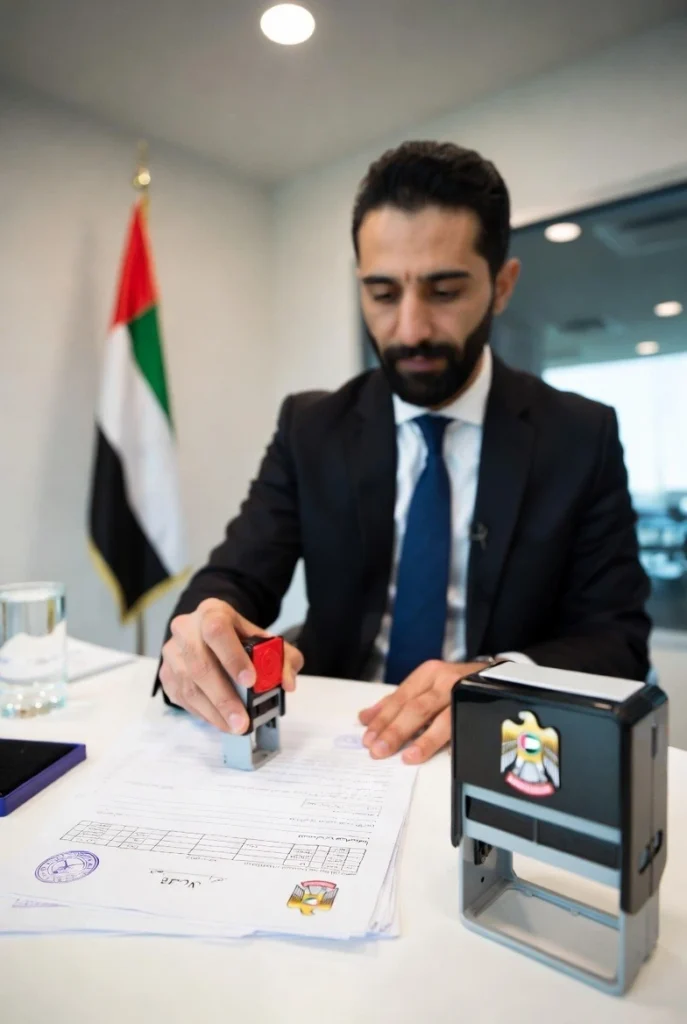
Why Document Notarization Matters in UAE Corporate Practice
In commercial practice, notarization frequently appears at moments of legal significance: company formation, amendments to constitutional documents, execution of powers of attorney, share transactions, settlement arrangements, and cross-border legalization chains. What looks procedural on the surface often determines whether a document can actually be relied on, registered, or enforced.
The UAE notary framework gives this process real legal weight. The law defines notarization as the notary’s attestation of the instrument and recording it in the register. It further provides that electronic signatures and electronic documents notarized under the law carry the same evidentiary value as official signatures and instruments under the UAE law of evidence.
For executives and legal teams, the practical point is straightforward: notarization in the UAE is often not about form alone. It is about making the document operationally effective — accepted by the authority, enforceable by the court, or recognized by the counterparty.
The Legal Basis of Notarization in the UAE: Federal Decree-Law No. 20 of 2022
The current federal framework governing document notarization in the UAE is centered on Federal Decree-Law No. (20) of 2022 Regulating the Notary Profession. The law applies to all persons performing notarial duties across the UAE, including in free zones, while recognizing that local judicial authorities may regulate notarial services under supplementary local legislation.
The law identifies the core functions of a UAE notary, which include: notarizing documents and contracts, administering oaths, notarizing signatures on instruments, drafting and notarizing affidavits, establishing the date of private instruments, notarizing non-Muslim wills, and affixing the executory formula where legally permitted. These functions cover the full range of document types that companies commonly need notarized in the course of their operations.
This framework was supplemented by Cabinet Resolution No. (16) of 2024, which issued the Executive Regulations governing the notary profession in practice. Together, the law and its regulations form the operative legal basis for notarization in the UAE today.
Public Notaries vs. Private Notaries in the UAE: Key Differences for Businesses
One of the most important practical distinctions for UAE businesses is the difference between Public Notaries and Private Notaries, both of which are recognised under federal law.
Under Federal Decree-Law No. 20 of 2022, public notaries are part of the formal notarial infrastructure and operate through official judicial and government channels. Private notaries are licensed individuals entered into the competent register and authorized to perform notarial services in accordance with the law and its regulations. The law further states that a private notary may perform their duties through a licensed office or licensed law firm, subject to applicable controls.
For UAE businesses, the strategic difference between the two is usually operational rather than legal. Public notary channels remain the standard route for many transactions, particularly those closely tied to judicial platforms, government registries, or authority-facing procedures. Private notaries can offer greater scheduling flexibility, a more tailored service experience, and faster turnaround in complex multi-party transactions or time-sensitive document execution scenarios. That operational flexibility has made private notary support increasingly relevant for sophisticated commercial work in the UAE.
Document Notarization in Dubai: How the Process Commonly Works
Dubai offers notarial access through official judicial channels. The Dubai Courts services platform remains the central access point for users seeking standard notary services through the public notary route. In parallel, the Ministry of Justice E-Notary System provides a federal digital framework for electronic notary submission, document search, and verification.
In practical terms, a corporate notarization process in Dubai commonly involves the following steps:
- Reviewing the document in final form to confirm it is complete, correctly drafted, and suitable for notarization.
- Confirming the authority of the signatory — this is especially important for company documents, where the signatory must be authorized consistently with the trade licence, constitutional documents, and any relevant board resolutions.
- Collecting supporting company documents, including the trade licence, Memorandum of Association, Emirates ID or passport copies, and any board authority records required by the notary channel.
- Submitting the request through the relevant channel — whether the Dubai Courts platform, the Ministry of Justice E-Notary System, or a private notary office.
- Completing any in-person or digital verification step required by the authority.
- Receiving the notarized instrument, certified output, or registered record.
The exact steps vary depending on the document type and the authority involved. However, one principle applies universally: the signatory must be properly authorized, and the supporting corporate records must be consistent with the authority being claimed. This is where many corporate notarization processes fail — not because of a problem with the document itself, but because of missing or inconsistent authority records.
Notarization Fees in Dubai: What Businesses Should Know
For businesses budgeting a transaction, UAE notary fees should be treated as a planned legal execution cost rather than an afterthought. Dubai’s published fee schedule has historically included the following benchmarks:
- AED 300 per party for attestation of signatures on an instrument with a stated value not exceeding AED 100,000.
- 5% of the instrument value (up to a maximum of AED 15,000) for instruments with a stated value exceeding AED 100,000.
- AED 200 per party where the instrument’s value is not specified.
- AED 100 per party for a general or special power of attorney.
- AED 500 for affixing the executory formula on an instrument.
These figures reflect the official published schedule and should be treated as a reference point. Fee structures and service channels can be updated administratively, so businesses should confirm the current applicable fees before filing — particularly for high-value commercial documents or multi-step transaction procedures where several notarial acts may be required.
DIFC Courts Notary Service: A Separate Channel for Certain Users
For DIFC-based businesses, or users whose documents are intended for use within the DIFC legal ecosystem, the DIFC Courts Notary Service provides a dedicated alternative notarization channel.
According to the DIFC Courts, this service was established by Resolution No. 1 of 2025 and its authority was affirmed by Dubai Law No. 2 of 2025. The DIFC Courts state that the service authorizes Notary Officers to administer, witness, and attest oaths, affidavits, affirmations, declarations, and true copy documents. They also confirm that all notarized transactions are logged in Hedera’s Distributed Ledger Technology, supporting the digital integrity and verifiability of notarized records within the DIFC framework.
For many onshore UAE transactions, Dubai Courts or other local notary channels remain the standard and most broadly accepted route. The DIFC notary channel is most commercially relevant where the client is already operating within the DIFC ecosystem or where the document’s intended use, receiving authority, or counterparty context aligns specifically with DIFC procedures and standards.
Notarization vs. Attestation in the UAE: Understanding the Difference
Notarization and attestation are frequently used interchangeably in business discussions, but they are legally distinct processes that serve different purposes in the UAE document management chain.
Notarization is the formal act carried out by a UAE notary: witnessing and attesting the instrument, recording it in the notarial register, and giving it formal evidentiary status under UAE law. It is a domestic legal act performed within the UAE’s notarial framework.
Attestation — or legalization — is the subsequent chain of authentication required when a document must be recognized for use before foreign authorities or certain official bodies outside the UAE notarial framework. In many cross-border or international-use cases, a notarized document must move through several further stages: Ministry of Foreign Affairs authentication, and in some cases embassy or consular legalization depending on the destination jurisdiction and document type. The UAE Ministry of Foreign Affairs separately offers Documents Attestation as a formal service for both individuals and companies, confirming that attestation remains a distinct service layer beyond notarial execution.
Understanding this distinction matters practically: many businesses assume that having a document notarized in the UAE means it is ready for international use. In most cases, it is not — further attestation steps are required, and the pathway must be planned from the outset if the document is destined for use outside the UAE.
Digital Notarization in the UAE: The Legal Recognition of Electronic Documents
One of the most commercially significant features of the current UAE notarial framework is its express recognition of digital and electronic document execution. Federal Decree-Law No. 20 of 2022 recognizes electronic signatures, electronic information systems, and the evidentiary value of e-documents notarized in accordance with the law. The Ministry of Justice also maintains the E-Notary System for electronic submission and document verification.
For corporate users, this digital shift has practical consequences. It reduces friction in document handling, can shorten turnaround time in standard notarial matters, and enables remote or digital signing workflows for certain document categories. At the same time, it means that companies must pay closer attention to digital compliance, authorized signatory verification, and document integrity controls — because the process is increasingly system-driven and automated rather than purely paper-based and in-person.
Corporate Documents That Commonly Require Notarization in the UAE
In practice across UAE corporate transactions and governance matters, the following categories of document frequently require notarization or formal notarial involvement:
- Powers of attorney — particularly where the attorney will act before government entities, licensing authorities, registries, or counterparties requiring formal proof of authority.
- Share transfer and corporate amendment documents — especially where the transfer or amendment must be registered with a licensing authority or free zone regulator.
- Declarations and affidavits — used in litigation support, evidentiary filings, and statutory declarations required by UAE courts and authorities.
- Settlement instruments — where the parties wish to give a settlement agreement formal evidentiary status or use it in enforcement proceedings.
- True copy certifications — where a certified copy of an original document must be produced for banking, compliance, or cross-border use.
- Constitutional document amendments — in certain contexts where a change to the Memorandum or Articles of Association requires notarization before registration.
- Supporting documents for regulatory and licensing procedures — where a government authority or free zone regulator requires notarized supporting papers as part of a filing or approval process.
The exact requirement depends on the legal nature of the document and the authority receiving it. The critical planning principle for businesses is to identify the notarization requirement early in the transaction timeline — not as a last-minute closing step — to avoid delaying completion, registration, or enforcement.
Practical Risk Points: The Most Common Notarization Failures in UAE Companies
For corporate decision-makers, the most common notarization problems in the UAE are not usually legal complexity or obscure procedural requirements. They are execution failures that could have been avoided with basic pre-filing preparation.
The recurring issues are:
- Using an unauthorized signatory — presenting a document signed by someone whose authority is not reflected in the trade licence, constitutional documents, or current board resolutions.
- Presenting incomplete corporate records — attending a notarial appointment without the trade licence, Memorandum of Association, or relevant board authority documents the notary requires.
- Failing to prepare a required Arabic or bilingual version — where the receiving authority requires Arabic text or a bilingual document format, and only an English version has been prepared.
- Assuming notarization is the final step when attestation is also required — filing a notarized document internationally without completing the Ministry of Foreign Affairs attestation and any embassy legalization chain.
- Leaving notarization too late in the transaction timeline — creating delays at closing, registration, or enforcement because the notarial step was not built into the process from the outset.
A disciplined pre-filing review can prevent all of these issues. In higher-value transactions, document execution readiness — including notarization planning — should be part of the deal checklist from an early stage.
How Omam Legal Consultancy Supports Document Notarization in the UAE
At Omam Legal Consultancy, we support clients with the legal side of document execution, notarization readiness, and attestation planning across the UAE. Our work is focused on making sure that documents are properly prepared for the purpose they are meant to serve — not merely stamped.
Our support in this area commonly includes:
- Reviewing whether a document requires notarization and which channel is appropriate for the intended use.
- Checking signatory authority and supporting corporate records before the notarial appointment.
- Coordinating with legal translators and filing channels where Arabic versions or bilingual documents are required.
- Structuring powers of attorney and corporate instruments correctly before notarization.
- Advising on whether attestation, legalization, or further authentication will be required after notarization.
For boards, founders, and corporate legal teams, the objective is not only to obtain a stamp. It is to ensure the document is legally effective and procedurally accepted for the specific purpose it is intended to serve.
Notarization Is a Legal Control Point, Not a Clerical Step
Document notarization in the UAE is a legal control point that affects authenticity, authority, admissibility, and in many cases the ability to move a commercial matter forward. Under Federal Decree-Law No. 20 of 2022 and its 2024 Executive Regulations, the UAE has built a modern notarial framework that recognizes both public and private notaries, gives legal force to electronic notarization, and supports digital document handling across the system.
Alongside this, Dubai’s service channels through Dubai Courts, the federal E-Notary system, the DIFC Courts Notary Service, and the Ministry of Foreign Affairs attestation pathway together create a commercially functional — but procedurally complex — document execution environment. For businesses, the practical lesson is straightforward: when a document matters, the notarization plan matters equally. Getting that planning right from the start is far more cost-effective than addressing failures after the fact.
To better understand the broader legal and procedural landscape, you can explore our detailed resources on True Copy Notarization in Dubai and Certified True Copy in the UAE, which explain how document verification and certification work in practice. For cross-border use, our guide on UAE Embassy Attestation: All You Must Know outlines the full legalization process, while Document Certification in UAE: Who’s Qualified and Why It Matters clarifies who can legally certify documents and why it is important for compliance.
For individuals and businesses dealing with authority delegation and structuring matters, our Power of Attorney Abu Dhabi: Step-by-Step Guide provides practical insights into preparing and notarizing powers of attorney, while Corporate Structuring & Shareholding in the UAE explains how properly structured documentation supports governance, ownership clarity, and long-term business strategy. Together, these resources help ensure your documents are not only notarized, but also legally effective and accepted for their intended use.
Need to notarize a corporate document in the UAE?
Omam Legal Consultancy helps UAE businesses prepare documents for notarization, verify signatory authority, coordinate translation requirements, and manage the full notarization-to-attestation pathway with fewer delays and rejections.
Frequently Asked Questions: Document Notarization in the UAE
What is the difference between notarization and attestation in the UAE?
Notarization is the formal act performed by a UAE notary: verifying, witnessing, and recording the document in accordance with UAE notarial law. Attestation is a separate, subsequent authentication process required when the document must be recognized for use before foreign authorities or certain official bodies. The UAE Ministry of Foreign Affairs separately provides a document attestation service for this purpose. The two processes are distinct and not interchangeable.
Can documents be notarized electronically in the UAE?
Yes. Federal Decree-Law No. 20 of 2022 expressly recognizes electronic signatures, electronic documents, and electronic information systems in the notarization process. E-documents notarized under the law carry the same evidentiary value as traditionally notarized instruments. The Ministry of Justice also operates an E-Notary System for digital submission and verification.
What is a private notary in the UAE?
A private notary is a licensed individual listed in the competent notarial register and authorized under federal law to perform notarial services. Private notaries may operate through a licensed office or through a licensed law firm. They perform the same core notarial functions as public notaries but often offer greater scheduling flexibility and a more tailored service for corporate and time-sensitive matters.
Does Dubai have its own notary services channel?
Yes. Dubai Courts provides access to notary services through its official services platform and maintains its own published fee schedule for notarial services. Dubai also has a distinct regulatory framework for certain notarial functions operating alongside the federal notary law.
When would a UAE business use the DIFC Courts Notary Service?
The DIFC Courts Notary Service is most relevant for DIFC-registered entities, for documents intended to be used within the DIFC legal ecosystem, or where the counterparty, receiving authority, or transaction context aligns specifically with DIFC procedures. For most onshore UAE transactions, the standard Dubai Courts or federal notary route remains the appropriate channel.
Are powers of attorney commonly required to be notarized in the UAE?
Yes. Powers of attorney are among the most frequently notarized documents in UAE corporate and personal legal practice, particularly where the attorney will be acting before government entities, licensing authorities, registries, financial institutions, or counterparties that require formal proof of delegated authority. The notarized power of attorney is the standard mechanism for establishing that authority in a legally recognized form.
Do all notarized documents in the UAE also require attestation?
No. Whether attestation is required after notarization depends entirely on the intended use of the document and the receiving authority. Documents used domestically within the UAE for standard government filings, banking, or corporate purposes are usually complete once notarized. Documents intended for use before foreign authorities typically require further attestation through the Ministry of Foreign Affairs and potentially embassy or consular legalization.
What is the most common mistake UAE companies make in the notarization process?
The most common failure is preparing the document itself but not the authority behind it. Even a correctly drafted document will be delayed or rejected if the signatory’s authority is not properly reflected in the trade licence and constitutional documents, if required corporate records are missing from the notarial appointment, or if Arabic translation or bilingual formatting has not been arranged for the receiving authority. Pre-filing document readiness review is the most effective way to prevent this.