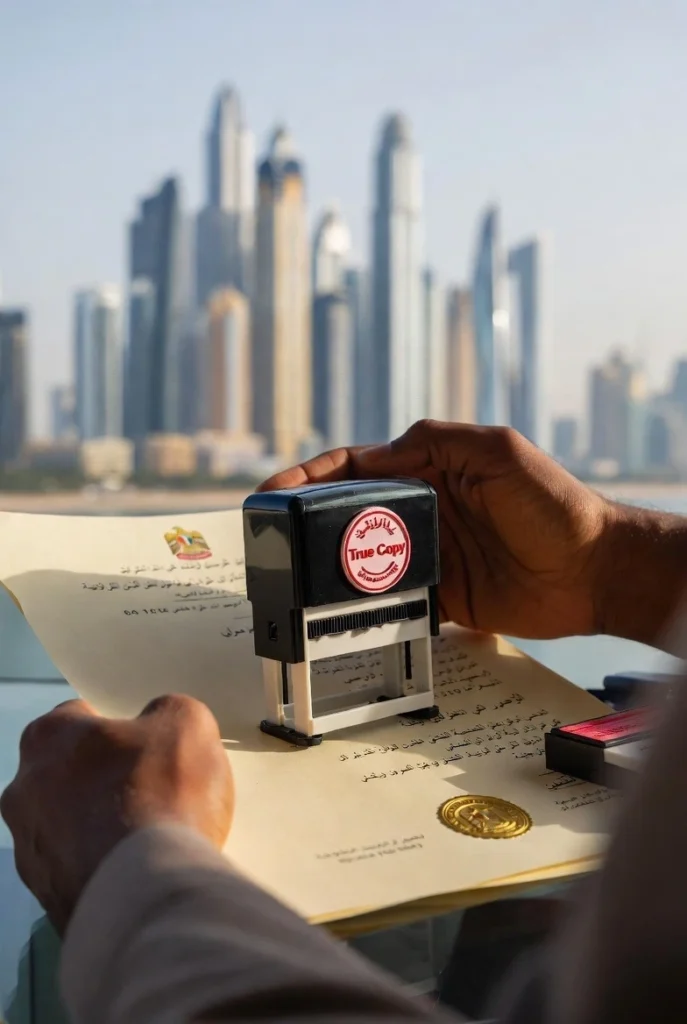
For companies registered in UAE free zones, certified true copies of corporate documents are a constant operational requirement. Whether a DMCC entity is opening a bank account, a Jafza company is responding to a due diligence request, or a DIFC-registered firm is participating in a cross-border financing, the need to produce properly certified copies of licences, constitutional documents, and authority records arises repeatedly. Yet many free zone companies continue to treat certification as an afterthought, discovering only when a filing is rejected that the copy was produced through the wrong channel or in the wrong format for the receiving institution.
At Omam Legal Consultancy, we advise free zone entities on document readiness, certification pathways, and UAE notarial and attestation requirements. This guide is written specifically for founders, in-house counsel, and corporate administrators working within the UAE free zone environment.
Why True Copy Certification Is a Recurring Issue for Free Zone Companies
Free zone companies in the UAE typically maintain a range of foundational corporate documents: the trade licence, the certificate of incorporation, the memorandum and articles of association, share certificates, board resolutions, and powers of attorney. These documents are frequently requested by banks, regulators, government authorities, joint venture partners, and foreign counterparties.
The challenge is not producing copies. The challenge is ensuring those copies are certified in a form that the receiving party will accept. Three problems come up repeatedly:
- The certification route used is not recognised by the institution receiving the document.
- The format or endorsement does not meet the receiving authority’s specific requirements.
- The company assumes a certification accepted by one institution will be accepted by another — and discovers too late that it will not.
For a free zone company with a commercial transaction, banking relationship, or regulatory filing at stake, these problems can cause delays and risks that could have been avoided with early legal input.
What Is a Certified True Copy?
A certified true copy is a copy of an original document that has been checked against the original by an authorized certifier, who confirms in writing that the copy is a complete and accurate reproduction of the document presented. The certification confirms the match between copy and original. It does not confirm the legal validity of the underlying document, the authority of the person who signed it, or whether the document remains current.
For free zone companies, this distinction matters because a certification accepted for a straightforward KYC submission may not be sufficient for a legal proceeding, cross-border filing, or transaction requiring a notarized or legalized document.
The Legal Framework Governing Certification and Notarization in the UAE
The federal framework for notarial practice — including certified true copy functions — is set out in Federal Decree-Law No. (20) of 2022 Regulating the Notary Profession and its executive regulations under Cabinet Resolution No. (16) of 2024. The law applies across the UAE, including free zones, while recognizing that local judicial authorities and financial free zones may maintain their own supplementary arrangements.
For DIFC-based entities, the DIFC Courts Notary Service now expressly offers certified true copy functions, including a dedicated true copy service with published fee structures for both individuals and corporate users. For most onshore and non-DIFC free zone entities, the main channels remain public notaries, private notaries, and specific free zone authority procedures.
Which Channel Should a Free Zone Company Use?
The correct certification channel depends on two factors: the type of document being certified and the receiving institution’s requirements. These are the most common scenarios:
Banking and Compliance Submissions
Banks conducting KYC and compliance reviews for free zone company accounts typically accept certified true copies produced through recognized legal channels. Public notaries and private notaries are generally acceptable for most bank submissions, but some international banks operating in the UAE may have specific format requirements. For DIFC-incorporated entities, the DIFC Courts Notary Service may be a natural and accepted route.
The safest approach is to confirm the bank’s requirements before producing the certified copy rather than assuming a standard format will be accepted.
Regulatory and Government Filings
Submissions to government authorities, RERA, the DLD, or free zone regulators may require certification through specific channels that the authority recognizes. Some authorities require notarization through Dubai Courts or a registered public notary. Others may have their own internal procedures. A certified copy produced by a law firm may not be sufficient without further notarization.
Cross-Border and International Use
Where free zone company documents are being used abroad — for example, as part of an international contract, a foreign entity registration, or a cross-border financing — certified true copies are often only a first step. The recipient jurisdiction may require attestation through the UAE Ministry of Foreign Affairs and then further authentication through the relevant embassy or consular channel.
This means that for cross-border use, the certification pathway must be planned from the end point backwards: what does the receiving jurisdiction and authority actually require, and does the UAE-certified copy form the correct starting point for that chain?
Corporate Transactions and Due Diligence
In share transfers, acquisitions, or due diligence exercises involving a free zone company, certified true copies of the licence, incorporation certificate, constitutional documents, and relevant resolutions are standard requirements. The counterparty’s lawyers or the relevant authority will usually specify the required certification standard, and the free zone company’s administrators should plan accordingly
Common Mistakes Free Zone Companies Make
Based on our experience advising free zone entities, the most common certification mistakes are:
- Certifying copies without checking what the receiving institution specifically requires — resulting in rejection and delay.
- Using a law firm certification where a notarial certification is required, or vice versa.
- Producing a certified copy of an outdated document — for example, a licence that has since been renewed or a constitutional document that has been amended.
- Failing to account for translation requirements where the document is in English but the receiving authority requires Arabic or a bilingual version.
- Assuming that a certified copy sufficient for one stage of a process will be automatically sufficient for the next stage, particularly in attestation or legalization chains.
Free Zone-Specific Considerations
Different free zones have different document standards and administrative procedures. Some points that are frequently relevant include:
DMCC
DMCC issues its own certificates of incorporation and company licences through its member portal. Copies of DMCC-issued documents may need to be certified through a recognized notarial channel before being submitted to external parties, depending on the receiving institution’s requirements.
DIFC
For DIFC-registered entities, the DIFC Courts Notary Service provides a dedicated notarial route that explicitly covers certified true copies. This service is published as accessible to both individuals and corporations and operates within the DIFC’s regulated legal framework. For documents being used internally within the DIFC ecosystem, this is often the most direct and accepted route.
Jafza and Other Free Zones
Companies in Jafza and other UAE free zones that require certified copies for external use will generally need to use a public notary or private notary route recognized by the receiving institution. Jafza’s own administrative platform covers licensing and corporate record amendments, but external certification for third-party submissions typically requires a notarial channel.
How Omam Legal Consultancy Helps Free Zone Companies
At Omam Legal Consultancy, we help free zone entities identify the correct certification pathway before filing, avoid rejection risk, and manage document readiness across banking, regulatory, and transactional contexts. Our work commonly includes:
- reviewing the receiving institution’s certification requirements;
- identifying whether notarization, attestation, or legalization is also required;
- checking that corporate documents being certified are current and consistent with the company’s registered records;
- advising on Arabic translation or bilingual formatting requirements;
- and coordinating the certification process to align with transaction or filing deadlines.
For a more complete understanding of how document certification fits within the UAE legal framework, businesses should also consider related services such as True Copy Notarization in Dubai and Document Notarization in the UAE, which determine the validity and acceptance of documents across different authorities and jurisdictions. In many cases—particularly for regulatory filings or international use—certification alone is not sufficient, and additional steps may be required through Document Attestation Services to ensure the document is legally recognized outside the UAE.
At the same time, document readiness should always be aligned with the company’s broader legal structure. Matters such as Corporate Structuring & Shareholding in the UAE directly influence which documents are required, how authority is evidenced, and how corporate records are presented to banks, regulators, and counterparties. Taking a coordinated approach across certification, notarization, attestation, and corporate structuring helps businesses avoid delays, reduce rejection risk, and maintain legal consistency across all transactions.
Need certified true copies for your UAE free zone company?
Omam Legal Consultancy can review the certification pathway, identify the correct channel, and help prepare your corporate documents for banking, regulatory, or cross-border use.
Frequently Asked Questions
Can a UAE free zone company use a lawyer to certify its corporate documents?
In some cases yes, but acceptance depends entirely on the receiving institution. Many government-facing procedures and formal filings require notarization through a public or private notary. A law firm certification may be acceptable for certain bank submissions but not for regulatory filings or cross-border use. The receiving institution’s specific requirements must always be confirmed first.
Does a DIFC company have a different certification route?
Yes. The DIFC Courts Notary Service now provides certified true copy services specifically for DIFC-based entities and others operating within the DIFC framework. For matters outside DIFC, the standard UAE notarial routes apply.
Do certified copies of free zone documents need to be attested for use abroad?
In most cases, yes. Certified true copies used for international purposes will typically need to go through UAE Ministry of Foreign Affairs attestation and, depending on the destination, further embassy or consular legalization. The full chain depends on the receiving jurisdiction and the document type.
What documents should a free zone company certify as a matter of routine?
The most commonly certified documents for free zone companies include the trade licence, certificate of incorporation, memorandum and articles of association, share certificates, board resolutions, and powers of attorney. Certified copies of identity documents for shareholders, directors, and authorized signatories are also commonly required for banking and compliance submissions.
What is the difference between a certified true copy and an attested copy in the UAE?
A certified true copy confirms that the copy matches the original examined at the time of certification. Attestation is a further authentication step — usually involving the Ministry of Foreign Affairs and sometimes embassy or consular channels — required when the document is to be used for official or international purposes. For cross-border use, certification alone is rarely sufficient.